
I Built a Real-Life RPG System to Gamify My Life (in Notion)
I Built a Real-Life RPG System to Gamify My Life (in Notion)
Learn how to gamify your life using LiFE RPG 2.0, a gamified Notion template that turns tasks into quests, habits into XP, and goals into a real-life RPG system.
Learn how to gamify your life using LiFE RPG 2.0, a gamified Notion template that turns tasks into quests, habits into XP, and goals into a real-life RPG system.

God, I hate Saturdays wasted in a one more quest. The last winter I would spend a full day grinding on side missions with my half-read book covered with dust on the nightstand, having been judged by the game of a disappointed NPC. I was annoyed about the contrast and thus did something nerdy. I dedicated one month and cut apart each game that hooked me and thought to myself: What do my brains work with, and can I take it to real life?
It was not a magic formula, it turns out. It was merely more design: articulated objectives, real-time feedback, visible milestones and a reward that is merited. I made myself a little Life RPG system that was janky up to my standards, and, surprisingly, Monday mornings do not seem like boss fights that I am not ready to go to.
Why Gamifying Your Life Works (and why “motivation” isn’t the point)
It's shameful how easy it is for me to have an addiction to games. When I try studying Spanish or going to the gym my focus evaporates faster than my New Year's resolutions. I've given up on workout plans after 10 days and I've lived through areas of work where nothing tangibly changed, so that my brain just checked out.
Reality feels broken. I say that with love. I really love my life, but man, the interface of it sucks. Games isn't better because I'm somehow 'more disciplined' in it. In fact, they're better - because they're created to feed my brain the cookies of motivation that it craves, by using fast feedback loops.
The feedback loop problem: real life hides progress
After spending a month studying my favorite games (yeah, I've blown hundreds of hours in these digital worlds, don't judge), I noticed the same mechanics popping up everywhere:
Progress You Can Actually See: I level up, earn XP, and watch numbers go up. Fast.
Tunnel Vision by Design: One quest at a time, one clear objective on screen.
Momentum from Small Wins: Little victories stack up until I'm accidentally productive without the usual mental wrestling match.
Gamification isn’t a gimmick, it’s missing feedback
I was afraid of this approach being yet another in a long line of productivity gimmicks. But gamifying isn't about tacking on false points to bland tasks. It adds something that real life often lacks: clarity, feedback and a satisfying sense of progress.
Motivation isn't a moral virtue though. Normally, it's an end result of good UX design.
"Reality doesn't motivate us as effectively." - Jane McGonigal
When life is vague and not going anywhere, games become meaningful as they tell me where I am at all times, what I should be working on next, and what I'm going to get out of it for my effort.
Reimagining Your To-Do List as an RPG Adventure Map
You can imagine your everyday activities as an RPG map. The laundry isn't a chore - it's an side quest. Completing a project becomes a boss battle. Bring some friends into the mix as members of your party or guild to be accountable to each other and your routine becomes like an adventure rather than a matter of obligations.
Building Your Character & Skill Tree
We invest so many hours in games as we own the character. We call it, we train it, our destiny dominates it. In contrast, real life tends to be a condition of living the story of another person, of doing certain things we are told, not choosing them. That's why with my life's RPG, I begin with character making and then move on with missions.
Make it personal: name your avatar
Your avatar is a kind of identity anchor - something very small to help you recall that you are the game master. I choose a name and a focus of the season, strength, creativity, discipline, whatever I am working on. Your life, your rules.
Build a simple skill tree system
Think of your skill tree as a growth map. Nobody assigns your stats only you can. I have mine to be general with 4-6 branches remaining.
Health (sleep, workouts, nutrition)
Focus (deep work, screen limits, planning)
Learning (reading, courses, practice)
Relationships (calls, dates, community)
Side note: I added German as a branch once, and began to treat my experience with the Duolingo like side quests. It sounded ridiculous, but it worked because I decided to do it.
Define your leveling system (XP rules + level-ups)
Choose which tasks earn XP (even 10-minute efforts count)
Set a simple rule: 100 XP = Level Up
Create rewards: badges, ranks, or real-life treats
Full disclosure: I way overcomplicated my first skill tree and had to hack it back like an overgrown garden.
Organize quests in Notion with PARA Method
I store my quests using the PARA method: Projects (active quests), Areas (ongoing stats), Resources (guides), and Archives (completed runs). Habitica works for this, but I prefer Notion for full customization.
Turn chores into quests (LiFE RPG task management)
Every good RPG has a straight focus. In real life, I used to blow that off and write down vague goals like "be better." That's not a story, it's practically a sentence with some details left out. My favorite technique is to take that vague intention and turn it into a concrete mission, and one with a real antagonist.
Start with “why” and name the enemy
When I build a "boss fight" in my tracker, vague goals become obstacles I can actually battle:
"Be healthier" → Defeat the Sloth Dragon
"Improve finances" → Level Up Your Money Management Skills
Now my daily tasks aren't random chores – they're meaningful quests pushing my story forward.
Assign Experience Points (and decide what a level up costs)
Every action counts. That's the antidote to invisible progress. I keep experience points simple and consistent:
Task Quest | XP | Reward |
|---|---|---|
10-min workout | +5 | Progress toward "Defeat Sloth Dragon" |
Pay a bill/track spending | +3 | Coins + finance skill boost |
25-min focus sprint | +5 | Skill XP (study/work) |
I set a clear threshold: 100 XP = Level +1. The dopamine hit from checking "Quest Complete" is the magic, like watching an XP bar fill up. Simple but effective for keeping momentum.
Let failure earn XP too
If I am gone one day, the game is not over. I still earn Recovery XP by coming the following day and doing a miniature version or just writing something down about what went wrong. Because I can always see progress I'm less likely to give up on my own goals.
PARA method placement
My quests will be housed in Projects. Responsibilities lay in Areas. Learning materials go into Resources, and completed quests change into Archives. Even my email in box is a dungeon only opened by me (and my armour in this regimen being a timer plus a purpose).
The Progress Bar That Keeps You Going
Some of said games, there is no more addictive moment than watching that XP bar inch upwards. And each small thing you gain you crave for more. I use that same feeling in my life RPG, keeping track of simple progress.
The Science Behind Visible Progress (goal-gradient effect)
Psychologists refer to it as the goal-gradient effect. As you come closer to one finish line, the drive grows. In real life, I give up when I can't see movement. If I exert myself for a week and nothing happens, or if I do ten days of training and my body looks the same, my brain gets lost. Motivation then fizzles out.
Make progress impossible to miss (60-second rule)
I keep progress visible: a journal, an activity log, or a simple database. My rule is:
If I can't see my progress in 60 seconds flat, I'm probably tracking the wrong thing.
I focus on what I can count today, not what might change someday:
Minutes focused (XP for skills)
Tasks completed (quest progress)
Pages read or reps done (training stats)
Daily habit check-ins (streaks + small rewards)
Using loss & avoidance to protect focus
Sometimes I have this "don't break the chain" rule I impose on them. Apps like Forest are good examples of this concept: you plant a virtual tree as long as you are focused and as soon as you become distracted, the tree dies. That is a very small risk but it keeps me grinding because in games growth is not only on that victory screen, it is during the grind. And yes, some days my only entry is "showed up." In my system, though, that still counts.
Your Rewards Marketplace
Every good RPG has a marketplace, somewhere to exchange your money for something that will please you. My life RPG works the same way and makes effort into joy and keeps me motivated when I don't feel like putting in the effort and when my willpower is running low.
Create your Rewards Marketplace list (and price it in coins)
I have a short list of rewards that really mean something to me and that I assign coin values to. Coins are only earned through the completion of quests, which lent a sense of earned value to the rewards instead of a feeling of guilt-inducing purchases.
Reward | Price (coins) |
|---|---|
Fancy coffee | 10 |
New book | 60 |
Weekend trip | 300 |
My approach is simple, rewards should be small, frequent and relevant to my values. When my quest is for health, I avoid things that undermine health by eating them, except when I'm doing it on purpose and know the price.
Coins, rewards punishments, and kind boundaries
The games often use small penalties to keep the players involved. I keep my light like that: if I don't play in two days that mean five coins or a level. It is not a shameful punishment, just a nudge. Apps like Forest use loss aversion to manage focus, and other tools like Habitica or basic facilities in Notion can build these habits.
Add unpredictability (rare drops + surprise quests)
Games also capture our attention with uncertain elements: rare drops, secret missions and surprising plots. I paragon that with diversions every now and then. Once a week I roll a round that represents "rare" which could be a treat, a quest that they have to go on or bonus coins. It’s playful, not pressured.
FAQ: keeping your Life RPG system from falling apart
Is this just another productivity gimmick?
I get asked this a lot because I've abandoned enough planners and bullet journals to start a stationery museum. My life RPG approach is not about perfect systems, it is about gathering what actually motivates me and providing it structure - rules, maps, quests, rewards and even boss fights. The trick is to make that light enough that it increases productivity, rather than another abandoned project.
How Do I Prevent System Abandonment?
I make my system like a Gamified Task Manager and not a second job. Once a week I make a quick review: which quests moved on, which stood still and which should be deleted. When things get messy, I just dump everything into a single list, which is a "brain dump" and then I re-sort it according to PARA. After that, I have just one or two quests in process. If I'm working ten epic storylines, I'm not playing, I'm drowning.
Do I need a Notion gamification template, or can paper work?
Nope. Paper works great: one page for quests, one for rewards, one for a simple map of your week. I use Notion because PARA makes organization easier, but the magic is in the clarity, not the platform.
What if I’m not motivated by points? What Core Drive should I lean on instead?
Points are not the only motivational core drive in the Octalysis framework. I fall on Development & Accomplishment when I desire a consistent advancement, Social Influence when I require responsibility (my "guild" of friends and an occasion of a shared pursuit every week), and Loss Aversion when preserving a streak or deadline. My guideline: I am not trying to gamify it all but only those areas where I continue to lose.
TL;DR: Games are not inherently more motivating, they are just more well designed. Make a simple Life RPG: make your character and skill tree, turn tasks into quests, and watch the progress on a visual scale, and use the earned coins on real rewards. Make it loose, do not overthink and even failure can bring XP to you such that you do not give up on your own adventure.
God, I hate Saturdays wasted in a one more quest. The last winter I would spend a full day grinding on side missions with my half-read book covered with dust on the nightstand, having been judged by the game of a disappointed NPC. I was annoyed about the contrast and thus did something nerdy. I dedicated one month and cut apart each game that hooked me and thought to myself: What do my brains work with, and can I take it to real life?
It was not a magic formula, it turns out. It was merely more design: articulated objectives, real-time feedback, visible milestones and a reward that is merited. I made myself a little Life RPG system that was janky up to my standards, and, surprisingly, Monday mornings do not seem like boss fights that I am not ready to go to.
Why Gamifying Your Life Works (and why “motivation” isn’t the point)
It's shameful how easy it is for me to have an addiction to games. When I try studying Spanish or going to the gym my focus evaporates faster than my New Year's resolutions. I've given up on workout plans after 10 days and I've lived through areas of work where nothing tangibly changed, so that my brain just checked out.
Reality feels broken. I say that with love. I really love my life, but man, the interface of it sucks. Games isn't better because I'm somehow 'more disciplined' in it. In fact, they're better - because they're created to feed my brain the cookies of motivation that it craves, by using fast feedback loops.
The feedback loop problem: real life hides progress
After spending a month studying my favorite games (yeah, I've blown hundreds of hours in these digital worlds, don't judge), I noticed the same mechanics popping up everywhere:
Progress You Can Actually See: I level up, earn XP, and watch numbers go up. Fast.
Tunnel Vision by Design: One quest at a time, one clear objective on screen.
Momentum from Small Wins: Little victories stack up until I'm accidentally productive without the usual mental wrestling match.
Gamification isn’t a gimmick, it’s missing feedback
I was afraid of this approach being yet another in a long line of productivity gimmicks. But gamifying isn't about tacking on false points to bland tasks. It adds something that real life often lacks: clarity, feedback and a satisfying sense of progress.
Motivation isn't a moral virtue though. Normally, it's an end result of good UX design.
"Reality doesn't motivate us as effectively." - Jane McGonigal
When life is vague and not going anywhere, games become meaningful as they tell me where I am at all times, what I should be working on next, and what I'm going to get out of it for my effort.
Reimagining Your To-Do List as an RPG Adventure Map
You can imagine your everyday activities as an RPG map. The laundry isn't a chore - it's an side quest. Completing a project becomes a boss battle. Bring some friends into the mix as members of your party or guild to be accountable to each other and your routine becomes like an adventure rather than a matter of obligations.
Building Your Character & Skill Tree
We invest so many hours in games as we own the character. We call it, we train it, our destiny dominates it. In contrast, real life tends to be a condition of living the story of another person, of doing certain things we are told, not choosing them. That's why with my life's RPG, I begin with character making and then move on with missions.
Make it personal: name your avatar
Your avatar is a kind of identity anchor - something very small to help you recall that you are the game master. I choose a name and a focus of the season, strength, creativity, discipline, whatever I am working on. Your life, your rules.
Build a simple skill tree system
Think of your skill tree as a growth map. Nobody assigns your stats only you can. I have mine to be general with 4-6 branches remaining.
Health (sleep, workouts, nutrition)
Focus (deep work, screen limits, planning)
Learning (reading, courses, practice)
Relationships (calls, dates, community)
Side note: I added German as a branch once, and began to treat my experience with the Duolingo like side quests. It sounded ridiculous, but it worked because I decided to do it.
Define your leveling system (XP rules + level-ups)
Choose which tasks earn XP (even 10-minute efforts count)
Set a simple rule: 100 XP = Level Up
Create rewards: badges, ranks, or real-life treats
Full disclosure: I way overcomplicated my first skill tree and had to hack it back like an overgrown garden.
Organize quests in Notion with PARA Method
I store my quests using the PARA method: Projects (active quests), Areas (ongoing stats), Resources (guides), and Archives (completed runs). Habitica works for this, but I prefer Notion for full customization.
Turn chores into quests (LiFE RPG task management)
Every good RPG has a straight focus. In real life, I used to blow that off and write down vague goals like "be better." That's not a story, it's practically a sentence with some details left out. My favorite technique is to take that vague intention and turn it into a concrete mission, and one with a real antagonist.
Start with “why” and name the enemy
When I build a "boss fight" in my tracker, vague goals become obstacles I can actually battle:
"Be healthier" → Defeat the Sloth Dragon
"Improve finances" → Level Up Your Money Management Skills
Now my daily tasks aren't random chores – they're meaningful quests pushing my story forward.
Assign Experience Points (and decide what a level up costs)
Every action counts. That's the antidote to invisible progress. I keep experience points simple and consistent:
Task Quest | XP | Reward |
|---|---|---|
10-min workout | +5 | Progress toward "Defeat Sloth Dragon" |
Pay a bill/track spending | +3 | Coins + finance skill boost |
25-min focus sprint | +5 | Skill XP (study/work) |
I set a clear threshold: 100 XP = Level +1. The dopamine hit from checking "Quest Complete" is the magic, like watching an XP bar fill up. Simple but effective for keeping momentum.
Let failure earn XP too
If I am gone one day, the game is not over. I still earn Recovery XP by coming the following day and doing a miniature version or just writing something down about what went wrong. Because I can always see progress I'm less likely to give up on my own goals.
PARA method placement
My quests will be housed in Projects. Responsibilities lay in Areas. Learning materials go into Resources, and completed quests change into Archives. Even my email in box is a dungeon only opened by me (and my armour in this regimen being a timer plus a purpose).
The Progress Bar That Keeps You Going
Some of said games, there is no more addictive moment than watching that XP bar inch upwards. And each small thing you gain you crave for more. I use that same feeling in my life RPG, keeping track of simple progress.
The Science Behind Visible Progress (goal-gradient effect)
Psychologists refer to it as the goal-gradient effect. As you come closer to one finish line, the drive grows. In real life, I give up when I can't see movement. If I exert myself for a week and nothing happens, or if I do ten days of training and my body looks the same, my brain gets lost. Motivation then fizzles out.
Make progress impossible to miss (60-second rule)
I keep progress visible: a journal, an activity log, or a simple database. My rule is:
If I can't see my progress in 60 seconds flat, I'm probably tracking the wrong thing.
I focus on what I can count today, not what might change someday:
Minutes focused (XP for skills)
Tasks completed (quest progress)
Pages read or reps done (training stats)
Daily habit check-ins (streaks + small rewards)
Using loss & avoidance to protect focus
Sometimes I have this "don't break the chain" rule I impose on them. Apps like Forest are good examples of this concept: you plant a virtual tree as long as you are focused and as soon as you become distracted, the tree dies. That is a very small risk but it keeps me grinding because in games growth is not only on that victory screen, it is during the grind. And yes, some days my only entry is "showed up." In my system, though, that still counts.
Your Rewards Marketplace
Every good RPG has a marketplace, somewhere to exchange your money for something that will please you. My life RPG works the same way and makes effort into joy and keeps me motivated when I don't feel like putting in the effort and when my willpower is running low.
Create your Rewards Marketplace list (and price it in coins)
I have a short list of rewards that really mean something to me and that I assign coin values to. Coins are only earned through the completion of quests, which lent a sense of earned value to the rewards instead of a feeling of guilt-inducing purchases.
Reward | Price (coins) |
|---|---|
Fancy coffee | 10 |
New book | 60 |
Weekend trip | 300 |
My approach is simple, rewards should be small, frequent and relevant to my values. When my quest is for health, I avoid things that undermine health by eating them, except when I'm doing it on purpose and know the price.
Coins, rewards punishments, and kind boundaries
The games often use small penalties to keep the players involved. I keep my light like that: if I don't play in two days that mean five coins or a level. It is not a shameful punishment, just a nudge. Apps like Forest use loss aversion to manage focus, and other tools like Habitica or basic facilities in Notion can build these habits.
Add unpredictability (rare drops + surprise quests)
Games also capture our attention with uncertain elements: rare drops, secret missions and surprising plots. I paragon that with diversions every now and then. Once a week I roll a round that represents "rare" which could be a treat, a quest that they have to go on or bonus coins. It’s playful, not pressured.
FAQ: keeping your Life RPG system from falling apart
Is this just another productivity gimmick?
I get asked this a lot because I've abandoned enough planners and bullet journals to start a stationery museum. My life RPG approach is not about perfect systems, it is about gathering what actually motivates me and providing it structure - rules, maps, quests, rewards and even boss fights. The trick is to make that light enough that it increases productivity, rather than another abandoned project.
How Do I Prevent System Abandonment?
I make my system like a Gamified Task Manager and not a second job. Once a week I make a quick review: which quests moved on, which stood still and which should be deleted. When things get messy, I just dump everything into a single list, which is a "brain dump" and then I re-sort it according to PARA. After that, I have just one or two quests in process. If I'm working ten epic storylines, I'm not playing, I'm drowning.
Do I need a Notion gamification template, or can paper work?
Nope. Paper works great: one page for quests, one for rewards, one for a simple map of your week. I use Notion because PARA makes organization easier, but the magic is in the clarity, not the platform.
What if I’m not motivated by points? What Core Drive should I lean on instead?
Points are not the only motivational core drive in the Octalysis framework. I fall on Development & Accomplishment when I desire a consistent advancement, Social Influence when I require responsibility (my "guild" of friends and an occasion of a shared pursuit every week), and Loss Aversion when preserving a streak or deadline. My guideline: I am not trying to gamify it all but only those areas where I continue to lose.
TL;DR: Games are not inherently more motivating, they are just more well designed. Make a simple Life RPG: make your character and skill tree, turn tasks into quests, and watch the progress on a visual scale, and use the earned coins on real rewards. Make it loose, do not overthink and even failure can bring XP to you such that you do not give up on your own adventure.
LiFE RPG
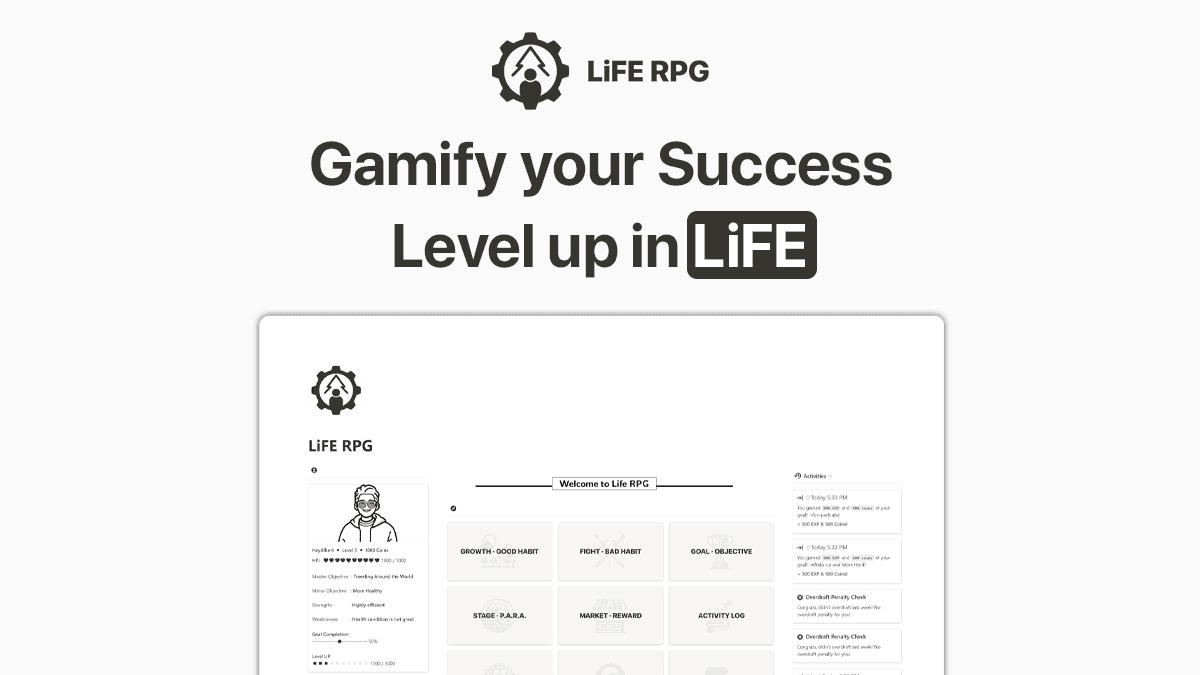
Gamify your Success, Level up in LiFE! The only Life Gamification System you need to Gamify your Life.
Subscribe to our newsletter
Tips, tools, tutorials, templates, and systems for gamifying your life.
Unsubscribe anytime.
Love it? Share it!